Data recovery from failed drives
When a drive fails, what matters is what is on it. CSD London recovers data from hard drives, SSDs, USB sticks, memory cards and RAID arrays at its East Sheen workshop, and treats every recovery as confidential.
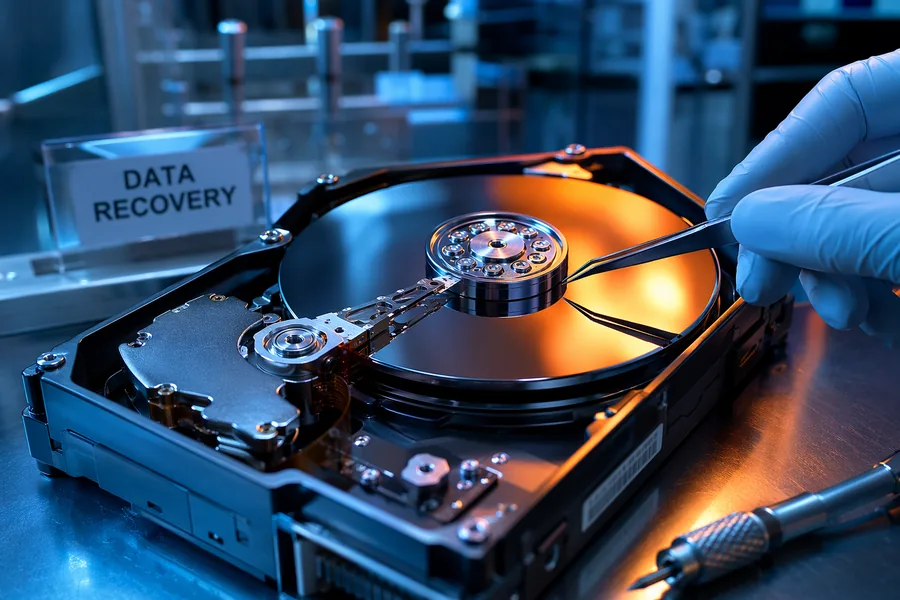
Stop using the drive
This is the single most useful thing you can do. Every further write to a failing drive reduces what can be recovered, and repeatedly powering on a mechanically failing disk can turn a recoverable fault into a permanent one. Disconnect it and bring it in.
What we recover from
Recovery is attempted from the full range of consumer and small-business storage.
- Mechanical hard drives that click, grind or are not detected
- SSDs that have stopped being recognised
- USB flash drives and SD or CF memory cards
- RAID arrays from small servers and NAS boxes
- Drives from laptops and desktops that will no longer boot
- Accidentally deleted or reformatted volumes
Honest assessment first
Not every drive is recoverable, and we would rather tell you that at the start than after a bill. The drive is assessed first and you are told what is realistically retrievable before any recovery work is agreed.
Common questions
- My external hard drive is clicking. What should I do?
- Switch it off and stop using it immediately. Clicking usually indicates a mechanical fault, and each further power-on risks additional damage to the platters. Bring the drive to CSD London in East Sheen for assessment rather than retrying it at home.
- Can data be recovered from a drive that is not recognised at all?
- Often, yes. A drive that does not appear to the computer may have a failed controller, power fault or logical corruption rather than destroyed data. It needs assessment to tell which.
- Is data recovery confidential?
- Yes. CSD London treats all recovered data as confidential, which matters particularly for business records, financial documents and personal photographs.
Related services
Secure data wiping before you recycle
Securely wipe old computers, hard drives, SSDs and NAS boxes before recycling or resale. Drop off in East Sheen, South West London. Call CSD London on 0208 876 8296.
Mac and MacBook repair in East Sheen
MacBook, iMac, Mac mini and Mac Pro repairs in East Sheen, South West London. Screens, batteries, logic boards and SSD upgrades, repaired in-house. Call 0208 876 8296.
Our East Sheen repair shop
CSD London, 233 Upper Richmond Road West, East Sheen SW14 8QS. Walk-in computer and Mac repair drop-off. Mon–Fri 10am–6pm, Sat 10:30am–2:30pm. 0208 876 8296.